

Securing a position in the SAP ecosystem demands more than foundational technical skills, as contemporary interviews emphasize practical scenarios, system design, and strategic decision-making. SAP interview questions evaluate both theoretical grasp and the capacity to implement SAP tools within intricate business contexts. With shifting interview trends and role-tailored criteria, aspiring candidates need to grasp the purpose and core themes of these questions, spanning functional expertise, technical proficiency, and case-based troubleshooting.
SAP Interview Questions Overview: Entry-Level and Professional
Before delving into specific questions, it’s important to identify the main areas that are typically covered.These can vary based on experience level, the target role, and the SAP module chosen. However, several key themes are consistent across different roles:
Key Question Categories
Upsurge Infotech – Best SAP Classes in India offers top-tier preparation across these areas.
Core Fundamentals: SAP basics, ERP concepts, and key terms.
Module Deep Dives: Functional (e.g., FICO, MM, SD) or technical specifics.
Scenario Simulations: Pressure-tested, real-world challenges.
Tech Proficiency: Config, custom dev, and optimization techniques
Upsurge Infotech, known as the best SAP classes in India, provides comprehensive guidance across these areas.Core Fundamentals: This includes an understanding of SAP basics, ERP concepts, and key terminology.
For Freshers:
Q1. What is SAP FI and its Components?
A. SAP FI (Financial Accounting) helps manage financial processes efficiently. It includes components such as the General Ledger, Accounts Payable, Accounts Receivable, and Asset Accounting, which handle day-to-day financial transactions.
Q2. What is the difference between SAP FI and SAP CO?
A. SAP FI is used for external financial reporting and compliance with laws, while SAP CO is focused on internal financial management, such as cost tracking and profitability analysis.
Q3. What is SAP MM, and What are the Benefits? Introduction to Key Features.
A. SAP MM (Materials Management) deals with purchasing and inventory management. It covers areas like purchase requisitions, orders, vendor management, inventory tracking, and invoice verification.
Q4. What is the P2P cycle in SAP MM?
A. The P2P (Procure to Pay) cycle starts with a purchase requisition, followed by purchase orders, goods receipt, invoice verification, and finally payment to the vendor.
Q5. Name two features of SAP SD?
A. SAP SD (Sales and Distribution) manages the entire sales process from quotations to billing. Features include handling sales orders, delivery, billing, and integration with MM and FI modules.
For Experienced Professionals:
Q1. What are the Automatic Payment Program (APP) run steps in the T Code F110 in SAP FI?
A. The APP run involves defining payment methods for company codes and house banks, setting vendor master data, date settings, selection conditions, and schedule settings for payment runs.
Q2. Define the material ledger in SAP.
A. The material ledger tracks actual costs and accumulates price variances. It is necessary for multi-currency or multi-valuation scenarios, allowing parallel valuation using various accounting principles and accurate profitability analysis.
Q3. How do you do 3rd-party order processing in SAP SD?
A. Create a sales order with item category TAS, generating a purchase requisition converted to a purchase order.The vendor ships directly to the customer, and goods receipt triggers automatic billing.
Q4. Describe the status of credit management in SAP SD.
A. Credit management manages customer exposure by setting credit limits and conducting automatic checks. Key terms include credit exposure (open orders and receivables), credit blocks (when limits are exceeded), and integration with FI for real-time receivables.
Q5. What are the pricing procedures in SAP SD?
A. Pricing procedures are defined using condition types (such as discounts and surcharges), access sequences (search routines), and condition records (prices).
SAP Technical and Development Interview Questions – For Candidates
Technical SAP interview questions usually assess a candidate’s expertise in areas like programming, customization, and system administration.These questions are typically aimed at experienced professionals.Here are some of the most commonly asked SAP interview questions for experienced candidates:
Q1. What types of internal tables are there in SAP ABAP?
A. There are three types: Standard Tables (insertion order, duplicates allowed), Sorted Tables (automatically sorted), and Hashed Tables (use of hash algorithm, unique keys).
Q2. What is BAdI, and how is it different from user exits?
A. BAdI (Business Add-In) is an object-oriented enhancement that allows custom code without modifying standard programs.It is upgrade-safe and supports multiple implementations, unlike user exits.
Q3.What is the difference between classical and interactive reports?
A. Classical reports produce static output with no user interaction, whereas interactive reports allow drilling down and dynamic analysis based on user actions.
Q4. How do you improve the performance of an ABAP program?
A. Use database views instead of nested selects, limit the fields selected, use binary search for internal tables, avoid nested loops, and use SQL trace (ST05) for performance analysis.
Q5.What are the various SAP enhancements available?
A. SAP offers enhancements such as Customer Exits, BAdIs, Enhancement Points, and BTEs for FI/CO. BadI and Enhancement Points are the most upgrade-friendly options.
Q6.What is SAP HANA, and its advantages?
A. SAP HANA is a memory-based database that stores data in server memory to accelerate processing.It supports real-time analytics, column-store technology, and simplified data models.
Q7.What is the transport management system?
A. TMS (Transport Management System) manages changes across different SAP landscapes via transport requests, ensuring controlled change management between development, quality, and production systems.
Q8. How do you apply authorization concepts?
A. Authorization objects are linked to profiles within roles. Authorization is implemented through requirement analysis, object determination, role creation, and regular security audits.
Q9. What are the types of work in SAP Basis?
A. Work types include Dialog (interactive sessions), Background (job scheduling), Update (database updates), and Spool (print requests).
Q10. What is the difference between synchronous and asynchronous RFCs?
A. A synchronous RFC waits for the function to complete before proceeding, whereas an asynchronous RFC is invoked and continues execution without waiting for the result.
SAP Interview Format, Pattern, and Evaluation Criteria
The prior knowledge of the interview format really helps in building up confidence and the strategy required for cracking an interview successfully.
Format
The interview process consists of an HR screening, technical interviews with the consultants, a managerial round based on project experience, and the final HR round based on negotiation,
Pattern
Beginner-level candidates are asked conceptual questions about the basics of SAP.
Experienced professionals are asked configuration-based questions.
Technical roles require coding exercises
Functional roles focus on business processes.
Evaluation Criteria
The interviews judge the clarity of concepts, availability of practical experience, approach to solving problems from the problem domain, and communication skills. Knowledge of project management, teamwork, and knowledge on Integration are what really matter.
Common Mistakes Candidates Make During SAP Interviews
Being aware of these common mistakes will help you present better.
No examples from your experience: Give some real-world applications from your training or projects. If you have done some SAP courses online with case studies, mention them as well.
Overstating abilities: Be truthful about your competency level. Puffery stands out in the face of in-depth follow-up questions.
Forgetting Integration Knowledge: Speak about how the modules integrate rather than just talking about one singular module.
Not listening enough: Listen to the question carefully, organize your thoughts, and answer in a structured manner with relevant examples.
Pro Tips to Crack SAP Interviews Successfully
Intelligent planning and presentation of oneself are required to succeed.
1. Master End-to-End Business Processes
Know end-to-end business flows, such as procure-to-pay and order-to-cash. Sales order processing (Explain how sales order triggers inventory checks and creates finance postings).
2. Practice with the STAR Technique
S- structure responses with situation
T- Task
A- action
R- result
Describe situations, explain tasks, detail actions, and quantify results.
3. Stay Updated with Latest Developments
Stay informed with the SAP community blogs and have some knowledge of S/4HANA, Fiori, and cloud solutions in your interviews.
FAQs Related to SAP Interview Questions
Q1. Is SAP certification necessary for freshers?
A. No, but it is recommended. Certifications confirm your knowledge and give you an added advantage, particularly when you’re a fresher and have little domain expertise.
Q2. How many SAP modules does a fresher learn to make career in SAP ?
A. Master one major module thoroughly based on your qualification and work experience. It good to have an integration knowledge of cross modules as well. It will greatly help your profile.
Q3. Can non-technical graduates get a chance to give SAP interviews and work in IT?
A. Of course yes,, functional modules don’t require programming. Business acumen level skills and the right training help non-IT graduates land into SAP Jobs in IT Industry.
Q5. How long does it take to be eligible for interviews for SAP?
A. Freshers need 3 to 4 months of training. Seasoned IT professionals are able to transition in 6 to 8 weeks.
Real Students Journey Section
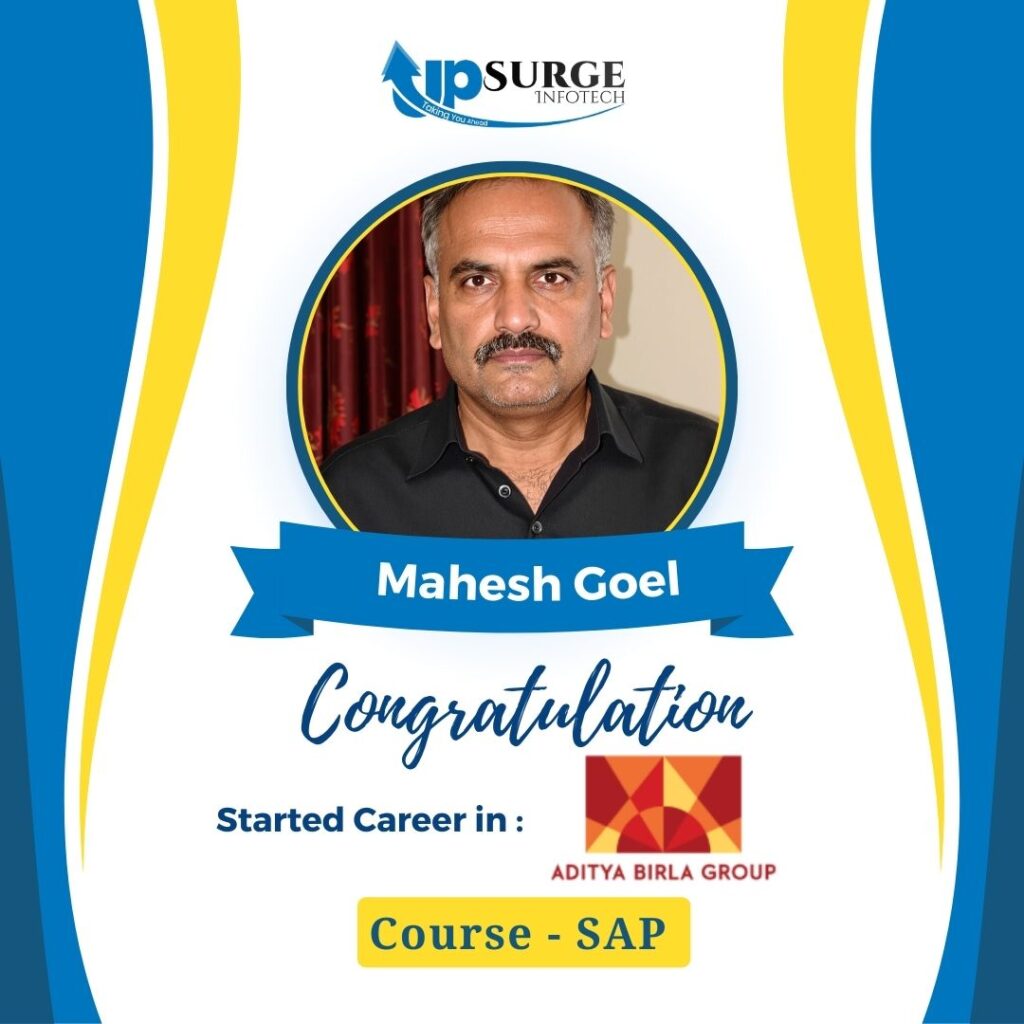
Upsurge Infotech SAP Placement Success Story of Mahesh Goel
Congratulations to Mahesh Goel on his well-deserved promotion as a SAP Consultant! With 9 years of dedicated user experience, Mahesh’s curiosity and perseverance have paid off, proving that anyone passionate about enterprise technology can make the leap to consulting. If you’ve ever wondered how SAP consultants crack complex business challenges, Mahesh’s journey shows it’s possible—with the right guidance and best SAP training institutes, anyone can step up and build new expertise.
For those aspiring to follow in his footsteps, investing in comprehensive SAP training and understanding SAP training fees is the first step towards a rewarding consulting career. Such transitions highlight that professional growth is always attainable for those willing to learn and adapt. Explore best SAP training options to boost your skills and get inspired by Mahesh’s path to success!
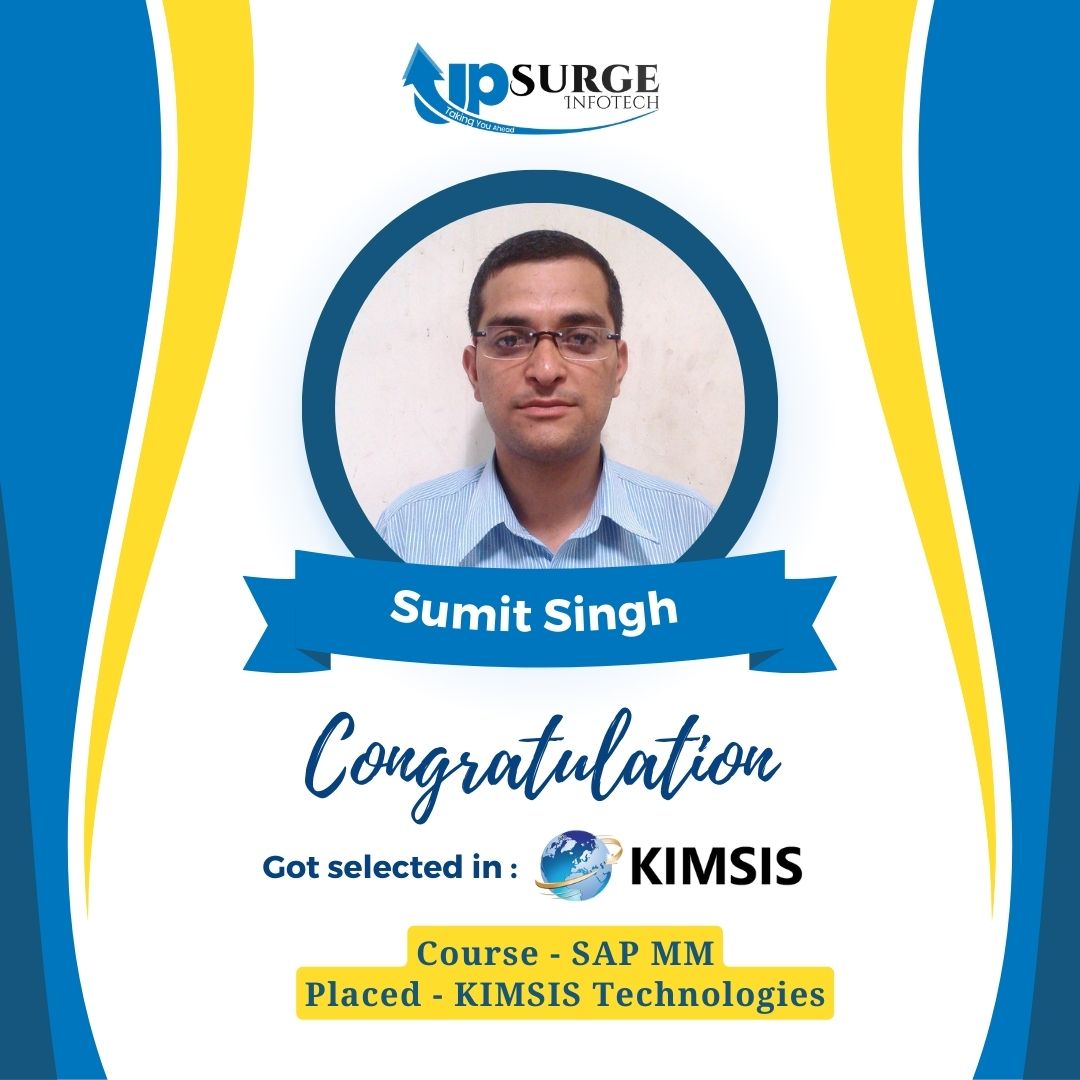
Upsurge Infotech SAP Placement Success Story of Sumit Singh
From Learning to Earning: Sumit Singh’s SAP MM Success!
Meet Sumit Singh, who started as an SAP End User but had bigger dreams. With dedication, upskilling, and the right guidance from Upsurge Infotech, he mastered SAP and secured a job at KIMSIS Technologies.
His Journey to Success:
✅ Started with basic SAP knowledge
✅ Enrolled in SAP MM Training to master procurement and inventory management
✅ Gained hands-on experience in real-world projects
✅ Faced 10+ interviews before landing the job
What Made It Possible?
✔ Right Training: Learning from experts boosted his confidence
✔ Hands-on Practice: Real-time SAP MM projects helped him stand out
✔ Never Giving Up: Every rejection was a step closer to success
Start Your SAP MM Success Story Today
📌 Learn from industry experts and gain practical experience
📌 Work on real-time projects to enhance your skills
📌 Get placement assistance and secure a high-paying SAP job
Upsurge Infotech SAP Placement Success Story No .3
Success Story: Nitesh Jadhav’s Journey to SAP MM at P&G!
Nitesh Jadhav started as an with basic knowledge but had a bigger goal to build a career in SAP . With the right training, hands-on practice, and determination, he successfully secured a job at P&G!At Upsurge Infotech, Nitesh gained expertise in SAP MM configuration, procurement, inventory management, and vendor management, working on real-world projects to build confidence. After facing multiple interviews and waited for almost 6 months, he finally achieved his dream roll
What Helped Him Succeed?
✅ Expert-Led SAP MM Training to master industry concepts
✅ Practical Learning with Hands-On SAP Projects
✅ Interview Preparation & Placement Assistance

Upsurge Infotech SAP Placement Success Story of Nitesh Jadhav
Success Story: Nitesh Jadhav’s Journey to SAP MM at P&G!
Nitesh Jadhav started as an with basic knowledge but had a bigger goal to build a career in SAP . With the right training, hands-on practice, and determination, he successfully secured a job at P&G!At Upsurge Infotech, Nitesh gained expertise in SAP MM configuration, procurement, inventory management, and vendor management, working on real-world projects to build confidence. After facing multiple interviews and waited for almost 6 months, he finally achieved his dream roll
What Helped Him Succeed?
✅ Expert-Led SAP MM Training to master industry concepts
✅ Practical Learning with Hands-On SAP Projects
✅ Interview Preparation & Placement Assistance
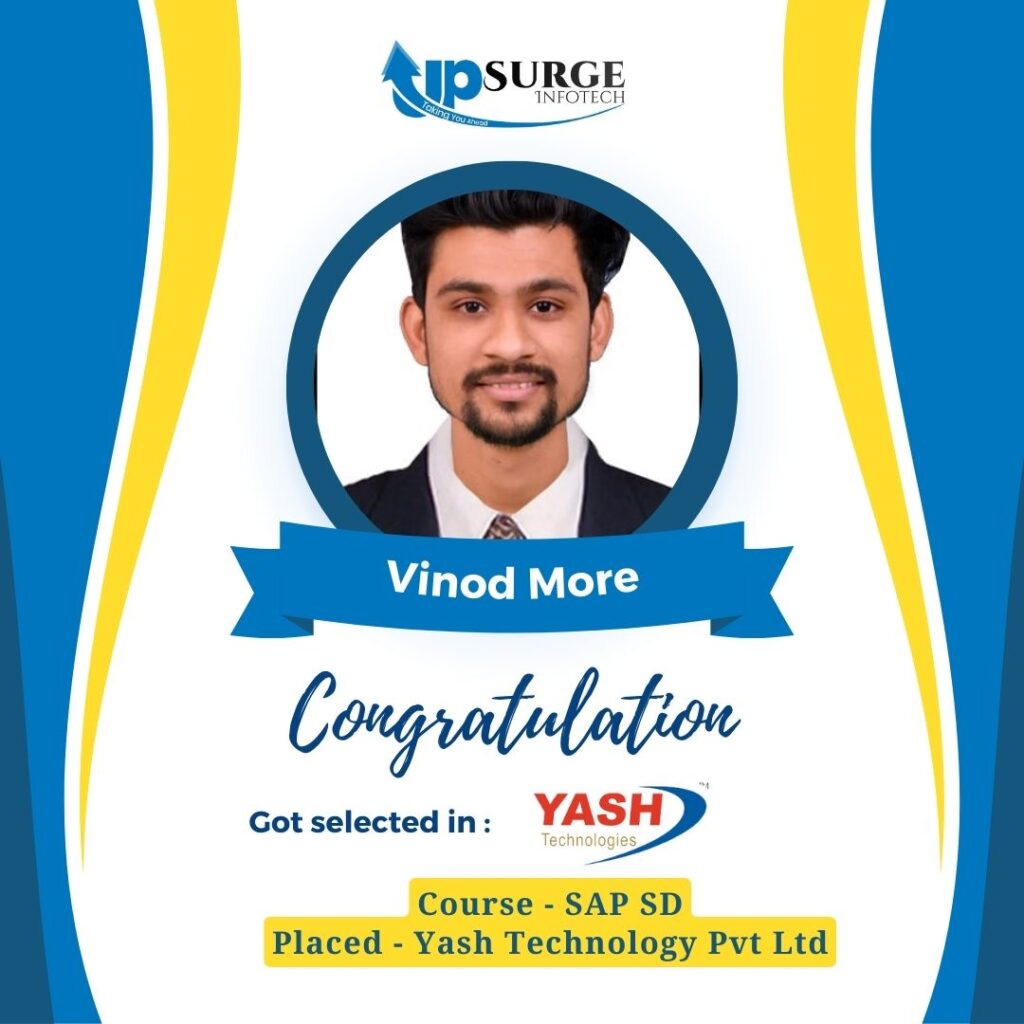
Upsurge Infotech SAP Placement Success Story of Vinod More
Vinod More’s Success Story: From Learner to SAP SD Professional at Yash Technologies
Meet Vinod More, who aspired to build a career in SAP Sales and Distribution (SAP SD). With the right SAP SD training, dedication, and hands-on experience, he successfully secured a job at Yash Technologies Pvt Ltd.
His Journey:
1. Started with a basic understanding of SAP SD as an end user.
2. Enrolled in a structured SAP SD course to learn pricing, order management, and billing.
3. Gained hands-on experience in SAP SD configuration and real-world projects.
4. Worked on real-time business scenarios to build expertise.
5. Finally got placed at Yash Technologies Pvt Ltd.

Learn from industry experts with real-time SAP projects. Gain expertise in order processing, invoice management, and pricing configuration.Get SAP certification training with placement assistance. Call now to enroll. Limited slots available.Admission Open for SAP Training Online At Upsurge Infotech – Best SAP Classes in India, blend theory, hands-on, and placements for success. Enroll for live projects and interview mocks