Data Analytics Course Guide 2026: Roadmap, Skills, Salary & Career Opportunities
Introduction to Data Analytics Course
In today’s world, where every click, purchase, and post leaves behind a trail of data, more and more people are realizing that a career in data analytics isn’t just for tech experts—it’s a practical path for anyone curious about turning everyday information into meaningful insights
Data has become the backbone of modern decision-making. Every industry—from finance to healthcare to e-commerce—relies on data to understand trends, improve performance, and predict future outcomes. Every time you order food online, binge-watch a series, or even scroll through Instagram, you’re leaving behind a trail of data. What’s fascinating is that this everyday information is shaping careers in data analytics — a field where ordinary curiosity about patterns and numbers can turn into extraordinary opportunities.
This shift has created massive demand for data analysts who can transform raw data into meaningful insights.The best part is ?
Data analytics is one of the few tech careers that:
- Doesn’t require heavy coding initially
- Is accessible to non-IT backgrounds
- Offers strong salary growth
In this guide, you’ll learn everything you need to know about becoming a data analyst expert in 2026.
What is Data Analytics?
Data analytics is the practice of examining raw data to uncover meaningful patterns, trends, and insights that help businesses and individuals make informed decisions. It transforms numbers and information into actionable knowledge. So the process of collecting, cleaning, analyzing, and interpreting data to make informed decisions.The goal is to convert raw information into insights that drive smarter strategies in areas like marketing, finance, healthcare, and technology.
A data analyst’s core role is to turn raw data into actionable insights by collecting, cleaning, analyzing, and presenting information that helps organizations make smarter decisions.
Key Tasks of a Data Analyst
Here are the main responsibilities that define what a data analyst does:
- Data Collection: Gather data from multiple sources such as databases, spreadsheets, APIs, and third-party providers.
- Data Cleaning: Remove errors, handle missing values, and ensure consistency so the dataset is reliable.
- Exploratory Data Analysis: Use descriptive statistics and visualizations to identify patterns, anomalies, and trends.
- Data Interpretation: Translate complex datasets into clear insights that non-technical stakeholders can understand.
- Visualization: Create charts, dashboards, and reports using tools like Tableau, Power BI, or Python libraries to make insights accessible.
- Reporting: Present findings to management and teams, often linking insights to business goals.
- Decision Support: Provide evidence-based recommendations that guide strategy, improve efficiency, and solve problems.
- Tool Usage: Work with SQL, Excel, Python, R, and visualization platforms to process and analyze data effectively.
Why Data Analytics is a Great Career in 2026
As businesses continue to rely on data-driven strategies the demand for data analytics professionals is stronger than ever skilled analysts are at the center of decision-making, innovation, and growth. Choosing a career in data analytics today means stepping into a future-proof profession with endless opportunities.
A career in data analytics is not just about crunching numbers—it’s about storytelling with data, solving real-world problems, and making an impact on global business decisions. With the right data analytics training program, you can position yourself as a sought-after professional in one of the fastest-growing fields.
Key Reasons to Pursue Data Analytics
High demand across industries: From healthcare to finance, companies are actively hiring analysts to interpret complex data and guide smarter strategies.
Lucrative career paths: With competitive salaries and global opportunities, data analytics offers financial stability and growth.
Versatile skill set: By enrolling in the best data analytics training program, you gain expertise in tools like Python, SQL, and Tableau that apply to multiple domains.
Accessibility: Whether you’re a student or a working professional, finding a data analytics course near me ensures you can upskill locally or online without disrupting your routine.
Future relevance: As AI, machine learning, and automation expand, data analytics remains the backbone of these technologies.
Step to Step Guide of Career In Data Analytics
Step 1: Learn Basics of Data
- What is data?
- Types of data (structured/unstructured)
- Basic statistics
Step 2: Excel (Foundation Tool)
- Data cleaning
- Formulas and functions
- Pivot tables
Step 3: SQL (Must-Have Skill)
- Data querying
- Joins and filtering
- Database concepts
Step 4: Data Visualization
- Power BI or Tableau
- Dashboard creation
- Data storytelling
Step 5: Basic Python (Optional but Powerful)
- Pandas
- NumPy
- Data analysis
Step 6: Projects
- Sales dashboard
- Customer analysis
- Business reports
What to Learn After Basics (Advanced Data Analytics)
To move into higher-paying roles, advanced skills are essential.
1. Advanced Excel Techniques
- Power Query
- Power Pivot
- Data modeling
2. Advanced SQL
- Complex joins
- Window functions
- Query optimization
3. Data Visualization Mastery
- Advanced dashboards
- Interactive reports
- Storytelling with data
- Power BI
- Tableau
4. Python for Data Analysis
Python enhances your analytical capabilities.
Libraries:
- Pandas (data manipulation)
- NumPy (numerical operations)
- Matplotlib / Seaborn (visualization)
5. Statistics for Data Analysis
Understanding statistics improves decision-making.
Key topics:
- Mean, median, mode
- Probability
- Hypothesis testing
6. Data Cleaning and Preprocessing
Real-world data is messy.
Learn:
- Handling missing values
- Removing duplicates
- Data transformation
7. Business Understanding
A good analyst understands business problems.
Focus areas:
- KPIs (Key Performance Indicators)
- Business metrics
- Industry-specific knowledge
Tools you must learn for Data Analytics
Core tools:
- Excel
- SQL
- Power BI / Tableau
Advanced tools:
- Python
- R (optional)
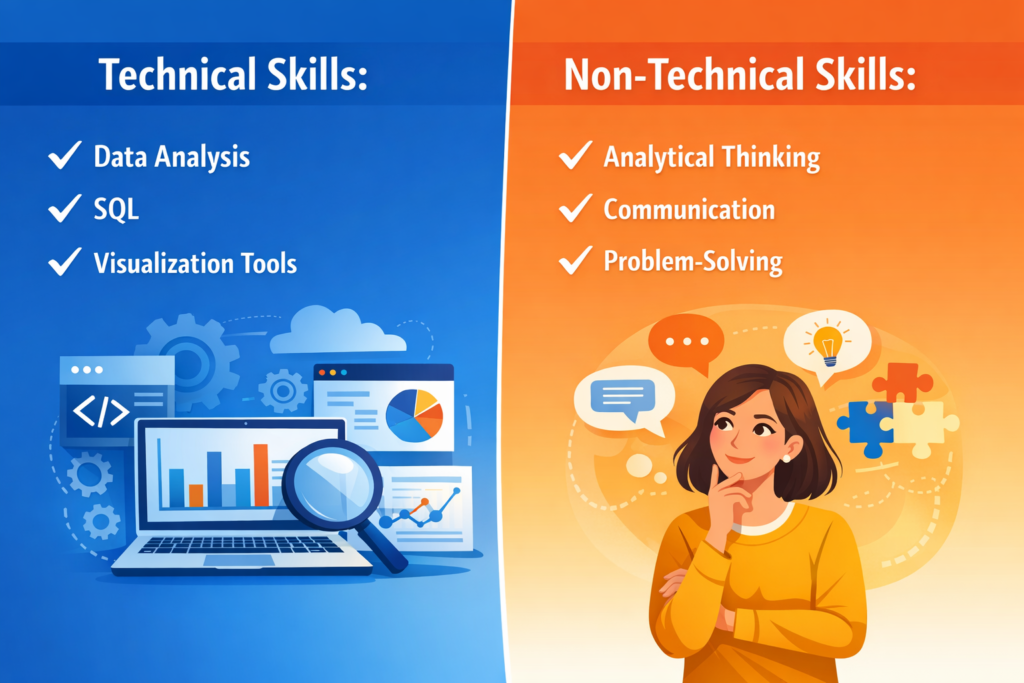
Skills Required for Data Analytics
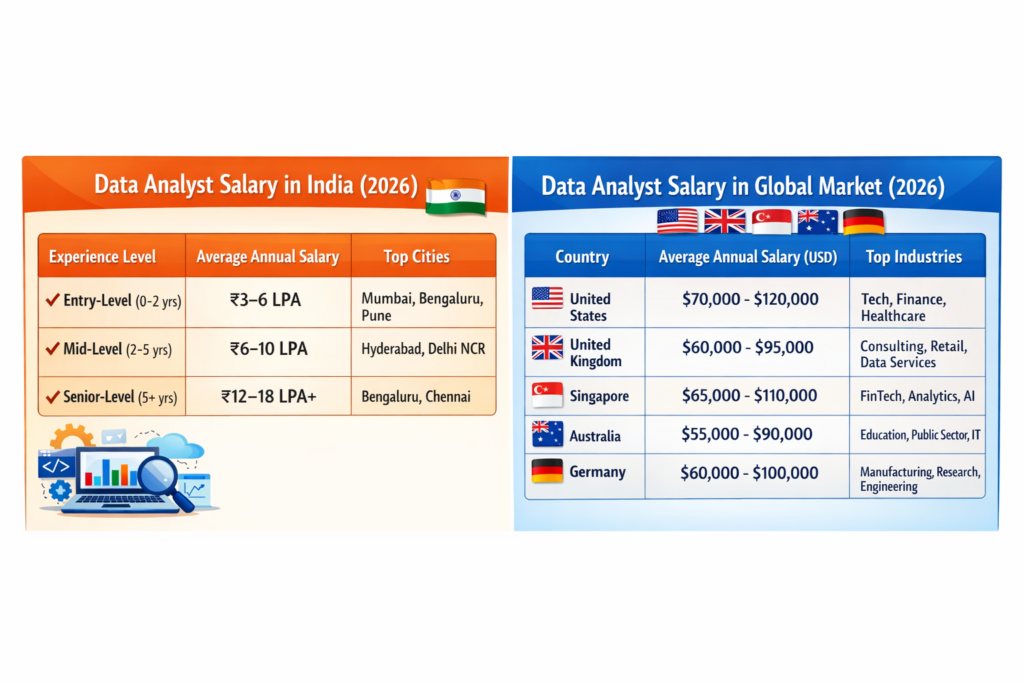
Data Analyst Salary in India (2026)
Difference between Data Analytics vs Data Science
Data Analytics and Data Science are closely related but differ in scope, complexity, and purpose — data analytics focuses on interpreting existing data to solve business problems, while data science uses advanced algorithms and predictive models to forecast future trends.
| Aspect | Data Analytics | Data Science |
| Primary Goal | Extract insights from existing data to improve decision-making | Build predictive models and algorithms to forecast outcomes |
| Focus Area | Business intelligence, reporting, and trend analysis | Machine learning, AI, and statistical modeling |
| Data Type | Mostly structured data (spreadsheets, databases) | Structured and unstructured data (text, images, social media) |
| Tools Used | Excel, SQL, Tableau, Power BI, Python (Pandas) | Python, R, TensorFlow, PyTorch, Hadoop |
| Techniques | Descriptive and diagnostic analytics | Predictive and prescriptive analytics |
| Output | Reports, dashboards, visual insights | Predictive models, algorithms, automation systems |
| Skill Level | Intermediate — focuses on interpretation | Advanced — focuses on experimentation and modeling |
| Career Roles | Data Analyst, Business Analyst, BI Specialist | Data Scientist, Machine Learning Engineer, AI Researcher |
If you’re starting out, enrolling in the best data analytics training program or a data analytics course near me is a great entry point. Once you master analytics tools and techniques, you can progress to data science specialization to learn machine learning and AI applications.
Both fields offer strong career growth — data analysts are essential for business strategy, while data scientists drive innovation through automation and predictive intelligence.
Common Mistakes Beginners Make when they consider career in Data Analytics
Beginners often make avoidable mistakes when starting a career in data analytics — such as focusing only on technical tools, ignoring business context, or skipping real-world practice — which can slow their growth and job readiness.
Mistake | Why It Happens | Better Approach |
Focusing only on technical skills | Many beginners think mastering Python, SQL, or Excel is enough. | Combine technical learning with business understanding and storytelling through data. |
Ignoring data cleaning | Beginners jump straight to analysis without preparing data properly. | Spend time on data preprocessing — clean, validate, and structure data before analysis. |
Skipping domain knowledge | Analysts often overlook how industry context shapes insights. | Learn the basics of the domain you’re analyzing (finance, marketing, healthcare, etc.). |
Neglecting visualization skills | Focusing only on numbers makes insights hard to communicate. | Use tools like Tableau or Power BI to present findings visually and clearly. |
Not practicing with real datasets | Relying on tutorials or theory limits practical understanding. | Work on open datasets (Kaggle, Google DataSets) to build hands-on experience. |
Poor communication of insights | Beginners often present data without explaining its meaning. | Learn to tell a story with data — connect insights to business outcomes. |
Avoiding collaboration | Many new analysts work in isolation. | Engage with online communities, mentors, and team projects to learn faster. |
Ignoring continuous learning | The field evolves quickly, and static skills become outdated. | Keep updating your knowledge through the best data analytics training program or certifications. |
How to Learn Data Analytics Effectively?
Lorem ipsum dolor sit amet, consectetur adipiscing elit. Ut elit tellus, luctus nec ullamcorper mattis, pulvinar dapibus leo.
Related Courses
Related Blogs




Related Videos