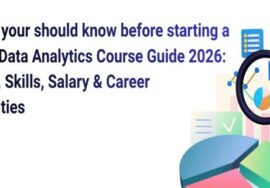
The Ultimate Data Analytics with AI Guide for Beginners & Professionals
Data Analytics training with AI empowers learners to transform raw data into actionable insights using automation, machine learning, and predictive modeling. For freshers, it’s a gateway to high‑growth careers; for professionals, it’s the fastest path to upskilling and leadership roles.
What is Data Analytics Training with AI?
Data Analytics training with AI is a structured program that teaches learners how to collect, clean, analyze, and interpret data using advanced AI tools.
AI enhances analytics by automating repetitive tasks, improving accuracy, and enabling predictive insights. This makes professionals more efficient and valuable in data‑driven industries.
Deep Dive:
- Traditional Analytics: Focuses on descriptive statistics, SQL queries, and dashboards.
- AI‑Driven Analytics: Adds machine learning, deep learning, and natural language processing to uncover hidden patterns.
- Industry Example: According to Deloitte, companies using AI in analytics reduce decision‑making time by up to 40%.
Why is Data Analytics Training Important Today?
The global data analytics market is projected to reach $650 billion by 2030 (Statista). AI is the driving force behind this growth.
Benefits for Freshers:
- Entry into high‑growth industries like IT, healthcare, and finance.
- Placement opportunities with multinational companies.
- Exposure to real‑world projects that build confidence.
Benefits for Professionals:
- Career advancement into managerial or specialist roles.
- Salary hikes (AI‑skilled professionals earn 30–40% more than traditional analysts).
- Ability to lead digital transformation initiatives.
Industry Insight: Gartner predicts that by 2027, 70% of enterprises will adopt AI‑driven analytics, making this skill indispensable.
What Skills Do You Learn in Data Analytics Training with AI?
Training programs cover both foundational analytics and advanced AI applications, ensuring learners are industry‑ready.
Core Skills Explained:
- Data Cleaning & Preprocessing: Handling missing values, duplicates, and inconsistencies.
- Statistical Analysis: Hypothesis testing, regression, and correlation.
- Machine Learning Algorithms: Decision trees, random forests, and neural networks.
- Predictive Modeling: Forecasting sales, demand, or customer churn.
- Data Visualization: Tools like Tableau, Power BI, and Matplotlib.
- AI Tools: TensorFlow, PyTorch, and cloud‑based AI services (AWS, Azure).
Step‑by‑Step Learning Path:
- Basics of Data Analytics – Learn Excel, SQL, and statistics.
- Programming for Analytics – Python/R for data handling.
- Machine Learning Foundations – Regression, classification, clustering.
- AI Integration – Neural networks, NLP, deep learning.
- Visualization & Reporting – Dashboards for decision‑making.
- Capstone Projects – Real‑world datasets for hands‑on practice.
What Career Opportunities Are Available?
AI‑powered analytics unlocks diverse career paths across industries, with strong demand for skilled professionals.
Top Roles:
- Data Analyst: Entry‑level role focusing on reporting and dashboards.
- Business Intelligence Analyst: Strategic role for decision‑making.
- Machine Learning Engineer: Builds predictive models and AI systems.
- AI Data Specialist: Integrates AI into analytics workflows.
- Data Scientist: Advanced role combining analytics, AI, and domain expertise.
Industries Hiring:
- IT & Cloud Computing: AWS, Microsoft, Google.
- Healthcare: Hospitals, pharma companies, healthtech startups.
- Finance: Banks, fintech firms, insurance companies.
- E‑commerce & Retail: Amazon, Flipkart, Walmart.
- Marketing & Advertising: Agencies using AI for customer insights.
Comparison: Traditional Data Analytics vs. AI‑Powered Analytics
Feature
Traditional Analytics
AI‑Powered Analytics
Speed
Manual, slower
Automated, faster
Accuracy
Human‑dependent
Machine‑optimized
Predictive Insights
Limited
Advanced forecasting
Scalability
Moderate
Highly scalable
Career Demand
Stable
Rapidly growing
Deep Dive: Traditional analytics is descriptive (what happened), while AI‑powered analytics is predictive and prescriptive (what will happen, what should be done).
How to Choose the Best Data Analytics Training Institute?
Selecting the right institute ensures quality learning, placement support, and industry recognition.
Key Factors Explained:
- Curriculum: Must include AI modules like machine learning and NLP.
- Faculty: Trainers with industry experience (not just academic).
- Placement Assistance: Tie‑ups with top companies.
- Flexibility: Online + offline options for working professionals.
- Certifications: AWS, Microsoft, and Google certifications add credibility.
Tip: Always check alumni reviews and placement records before enrolling.
Practical Applications of Data Analytics with AI
AI‑driven analytics is not just theory—it’s applied across industries to solve real problems.
Examples:
- Healthcare: Predicting patient outcomes and optimizing treatment plans.
- Finance: Fraud detection using anomaly detection models.
- Marketing: Customer segmentation & personalized campaigns.
- Retail: Inventory optimization with predictive analytics.
Case Study: According to McKinsey, AI‑driven analytics helped a retail chain reduce stockouts by 25%.
Tips for Freshers & Professionals
- Freshers: Focus on building strong foundations in statistics and Python.
- Professionals: Prioritize AI modules like deep learning and NLP.
- Both: Work on real‑world projects to showcase skills.
Pro Insight: According to LinkedIn’s 2026 Jobs Report, Data Analytics with AI is among the top 5 most in‑demand skills globally.
Frequently Asked Questions
What is the duration of Data Analytics training with AI?
Most programs range from 3 to 6 months, depending on depth and project work.
Do I need coding knowledge before enrolling?
Basic programming helps, but beginner‑friendly courses start from scratch.
What is the average salary after completing training?
Entry‑level roles start at ₹4–6 LPA, while experienced professionals can earn ₹12–20 LPA.
Is online training as effective as offline?
Yes, provided the institute offers live projects, mentorship, and placement support.
Which certification is most valuable?
AWS Certified Data Analytics and Microsoft Certified Data Scientist are globally recognized.
Related Courses
Related Blogs




Related Videos