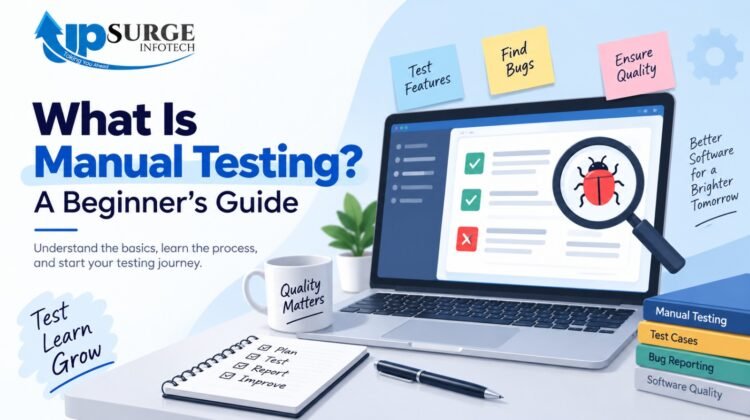
What Is Manual Testing? A Beginner’s Guide
What Is Manual Testing? — Quick Answer
Manual testing is the process of testing software manually, without using automated test scripts, to identify defects and verify that an application works as expected. A manual tester follows test scenarios, enters different inputs, compares actual and expected results, and reports defects to the development team.
For freshers and working professionals, manual testing is often one of the easiest entry points into a career in software testing and quality assurance (QA).
What Is Manual Testing?
Manual testing is a software testing method where a tester evaluates an application’s functionality by performing test cases manually rather than relying on automation scripts.
For example, imagine you are testing an online shopping website.
A manual tester might:
- Open the website
- Search for a product
- Add the product to the cart
- Apply a coupon
- Enter delivery details
- Make a payment
- Verify the order confirmation
The tester checks whether each step produces the expected result and records any unexpected behavior as a defect.
According to the International Software Testing Qualifications Board (ISTQB), software testing involves activities designed to evaluate software and identify defects, while its Foundation Level syllabus covers test planning, test design, execution, defect reporting, and other fundamental testing activities.
Manual testing is therefore not simply “clicking around a website.” It requires structured thinking, understanding requirements, designing test scenarios, identifying risks, and communicating defects clearly.
How Does Manual Testing Work?
In simple terms: A manual tester compares what the software should do with what it actually does. The process usually involves understanding requirements, creating test cases, executing them, reporting defects, and performing retesting and regression testing.
A typical manual testing process looks like this:
1. Understand the Requirements
The tester first understands what the application or feature is supposed to do.
For example:
Requirement: A user should be able to log in using a registered email address and password.
The tester then identifies possible scenarios around this requirement.
2. Create Test Scenarios
The tester thinks about different ways the feature can be used.
For a login page, scenarios could include:
- Valid email + valid password
- Invalid email + valid password
- Valid email + invalid password
- Empty email
- Empty password
- Both fields empty
- Incorrect email format
- Password length validation
3. Write Test Cases
A test case generally contains:
- Test case ID
- Test scenario
- Preconditions
- Test steps
- Test data
- Expected result
- Actual result
- Pass/Fail status
4. Execute the Test Cases
The tester performs the steps manually and compares the actual result with the expected result.
5. Report Defects
If the application does not behave as expected, the tester creates a defect report with relevant information such as:
- Defect title
- Steps to reproduce
- Expected result
- Actual result
- Severity
- Priority
- Screenshots or videos
- Environment details
6. Retest the Fix
After developers fix the defect, the tester executes the same scenario again to verify whether the issue has actually been resolved.
7. Perform Regression Testing
The tester checks whether the recent code changes have unintentionally affected existing functionality.
ISTQB specifically emphasizes that testing activities are normally tailored to the project and may be performed iteratively or in parallel rather than always following one rigid sequence.
What Are the Different Types of Manual Testing?
Manual testing includes several testing approaches depending on what needs to be evaluated.
Functional Testing
Functional testing checks whether software features work according to specified requirements.
For example, if an application has a “Forgot Password” feature, the tester verifies whether users can successfully reset their password.
IBM describes functional testing as verifying whether an application’s features work as expected based on specified requirements.
Regression Testing
Regression testing checks whether existing functionality continues to work after changes are made to the software.
For example, adding a new payment option should not break the existing checkout process.
Smoke Testing
Smoke testing is a quick, high-level check to determine whether a software build is stable enough for more detailed testing.
Sanity Testing
Sanity testing focuses on specific functionality after minor changes or bug fixes to determine whether the relevant area is working correctly.
Integration Testing
Integration testing checks whether different modules or components work correctly together.
System Testing
System testing evaluates the complete integrated application against specified requirements.
Exploratory Testing
Exploratory testing allows testers to simultaneously learn about the application, design tests, and execute them instead of relying entirely on predefined test cases.
This is particularly useful for discovering unexpected usability and functional issues.
What Is the Difference Between Manual and Automation Testing?
Manual testing depends primarily on human execution and judgment, while automation testing uses scripts and tools to execute predefined tests. In real-world QA environments, the two approaches often complement rather than completely replace each other.
Feature | Manual Testing | Automation Testing |
Test execution | Human tester | Automated scripts/tools |
Coding requirement | Usually low initially | Usually higher |
Initial setup | Relatively simple | Requires framework/setup |
Exploratory testing | Excellent | Limited |
Repetitive testing | Time-consuming | Highly suitable |
Speed | Slower for repetitive tests | Faster |
Human observation | Strong | Limited by script/design |
Maintenance | Test cases require updates | Scripts require maintenance |
Best suited for | Exploration, usability, changing features | Regression and repetitive scenarios |
According to IBM, traditional manual testing can involve substantial time and effort, particularly when testers have to repeatedly simulate complete user journeys. AI-assisted and automated approaches can help address some of these limitations, but human judgment remains important in software quality.
What Are the Advantages of Manual Testing?
Manual testing continues to be valuable because software quality is not only about executing the same steps repeatedly.
Key benefits include:
- Human judgment: Testers can recognize unusual behavior that a predefined script may not anticipate.
- Exploratory testing: Testers can investigate unexpected application behavior.
- Usability evaluation: Humans can assess whether an application feels intuitive and easy to use.
- Flexible test execution: Testers can quickly modify their approach when requirements change.
- Lower initial automation cost: Simple testing can begin without building an automation framework.
- Useful for frequently changing features: Constantly changing automated scripts can require significant maintenance.
ISTQB’s current Foundation Level syllabus also highlights that testing is context-dependent and that there is no single testing approach that works identically for every project.
What Are the Limitations of Manual Testing?
Manual testing also has limitations.
- Repetitive test execution can take considerable time.
- Human testers can make mistakes.
- Large regression suites can become difficult to execute manually.
- Test execution speed is limited by human effort.
- Maintaining consistent execution across thousands of test cases can be challenging.
- It is less efficient than automation for highly repetitive scenarios.
This is why many organizations use a combination of manual and automation testing training rather than treating manual testing and automation as competing careers.
What Skills Do You Need to Become a Manual Tester?
You don’t need to be an expert programmer to begin learning manual testing. However, you need strong analytical and communication skills.
Important skills include:
- Analytical Thinking
You should be able to think beyond the obvious “happy path” and ask, What could go wrong?
- Attention to Detail
Small differences between expected and actual behavior can reveal important defects.
- Software Testing Fundamentals
You should understand concepts such as:
- SDLC
- STLC
- Test cases
- Test scenarios
- Defect lifecycle
- Severity vs. priority
- Regression testing
- Smoke testing
- Sanity testing
- Functional testing
- Communication Skills
Testers need to explain defects clearly to developers, product managers, and other stakeholders.
- Basic SQL
SQL can help testers validate data stored in databases.
- API Testing Basics
Understanding APIs can make you more effective when testing modern applications.
- Basic Automation Knowledge
You don’t necessarily need to become an automation developer immediately, but understanding automation concepts can improve your long-term career opportunities.
Can Freshers Learn Manual Testing?
Yes. Manual testing is one of the more accessible entry points for people beginning a career in software QA. A fresher from a technical or non-technical background can build testing skills by learning fundamentals, practicing on real applications, and developing project experience.
However, completing a course alone does not guarantee a job.
A job-ready candidate should ideally know how to:
- Understand software requirements.
- Identify test scenarios.
- Write professional test cases.
- Execute different testing types.
- Report defects using appropriate tools.
- Perform retesting and regression testing.
- Understand basic SQL and API testing.
- Explain testing concepts confidently during interviews.
- Work with Agile/Scrum concepts.
- Demonstrate practical project experience.
The ISTQB Foundation Level curriculum similarly covers testing fundamentals, test techniques, test management, defect management, and tool support.
Is Manual Testing Still Relevant in the Age of AI?
Yes—but the role is evolving.
AI and automation can help testers generate test cases, identify patterns, analyze test results, create test data, and accelerate repetitive activities. However, testers still need to understand requirements, business risks, user expectations, and whether a test actually provides meaningful coverage.
In fact, IBM’s 2026 discussion of AI-assisted QA notes that manual testing can become a bottleneck when large numbers of end-to-end scenarios must be executed, while AI-assisted approaches can support testing activities.
The better career strategy is therefore:
Manual Testing → API & SQL → Automation → AI-assisted Testing
This combination can make a tester more adaptable as QA practices evolve.
What Tools Do Manual Testers Use?
Manual testers commonly work with tools for test management, defect tracking, collaboration, API testing, database validation, and documentation.
Examples include:
- Jira
- TestRail
- Zephyr
- Postman
- SQL tools
- Browser Developer Tools
- Confluence
- Git/GitHub
The exact tools vary by organization, but the underlying testing concepts remain transferable.
What Is the Career Path After Learning Manual Testing?
A beginner can gradually move through several QA career stages.
Fresher → Manual Tester → QA Engineer → Automation Tester → Senior QA Engineer → QA Lead
With additional specialization, professionals can also explore:
- API testing
- Performance testing
- Mobile testing
- Security testing
- Automation testing
- AI-assisted software testing
- Test management
The ISTQB Certified Tester scheme also provides Foundation, Advanced, Specialist, and Expert-level pathways for professionals who want to deepen their testing knowledge.
Frequently Asked Questions
Is manual testing easy for beginners?
Manual testing is relatively accessible for beginners because you can start with testing concepts before learning advanced programming. However, becoming job-ready requires consistent practice and understanding of real-world testing processes.
Does manual testing require coding?
Manual testing does not always require advanced coding knowledge. However, basic programming, SQL, APIs, and automation concepts can significantly improve your career prospects.
Can a non-IT graduate learn manual testing?
Yes, non-IT graduates can learn software testing if they are willing to understand software development concepts and practice testing techniques. A structured Software Testing Classes for Beginners program can provide a clearer starting point.
Is manual testing a good career for freshers?
Manual testing can be a practical entry point into QA for freshers. Candidates should combine manual testing fundamentals with SQL, API testing, Agile concepts, and eventually automation skills.
What is the difference between QA and manual testing?
Manual testing is a testing approach, while quality assurance is a broader discipline focused on improving software quality and development processes. Manual testing is therefore one part of the broader QA ecosystem.
Can I learn manual testing without a technical degree?
Yes. A technical degree is not the only factor determining success in testing; analytical thinking, communication, testing knowledge, and practical skills are also important.
Should I learn manual testing before automation testing?
For many beginners, learning manual testing fundamentals first makes automation easier to understand because you first learn what needs to be tested before learning how to automate it.
What should I learn after manual testing?
Consider learning SQL, API testing, Agile/Scrum, test management tools, and automation frameworks. If you’re interested in emerging QA roles, you can also explore AI-assisted software testing.
Start Your Software Testing Career
If you’re a fresher or working professional looking to enter QA, don’t stop at learning definitions. Focus on becoming job-ready through practical testing scenarios, real project exposure, defect reporting, SQL, API testing, and automation fundamentals.
If you’re searching for Software Testing Course Near Me, a Manual Testing course with placement, or Software Testing training with placement, choose a program that focuses on practical skills rather than only theoretical concepts.
For learners in Mumbai, a Software testing with AI course Mumbai can also be worth considering if you want to understand how traditional QA skills are evolving with AI.
Ready to start? Explore a Job Oriented Software Testing Course that combines manual testing fundamentals, practical projects, automation concepts, and career-focused training.
If you’re looking for the Best Software Testing Institute in Mumbai, compare the curriculum, trainer experience, practical exposure, placement support, and project work before enrolling.
Related Blogs




Related Videos