Skills Required to Become an SAP Functional Consultant
What skills are required to become an SAP Functional Consultant?
The most important skills required to become an SAP Functional Consultant are SAP module knowledge, business-process understanding, configuration skills, analytical thinking, communication, problem-solving, and real-time project exposure.
Freshers can enter SAP consulting by building expertise in one functional module such as SAP FICO, MM, SD, HCM, or SuccessFactors, while working professionals can leverage their existing domain experience to move into consulting.
What Does an SAP Functional Consultant Do?
An SAP Functional Consultant connects business requirements with SAP solutions. Instead of primarily writing code, the consultant understands how a company operates, identifies business requirements, configures SAP accordingly, tests the solution, and supports users during implementation or improvement projects.
According to SAP Help, consultant responsibilities can include analyzing clients, evaluating requirements, recommending solutions, preparing activities, and executing assigned project activities.
In practical terms, an SAP Functional Consultant may:
- Understand business requirements.
- Map existing business processes.
- Identify gaps between requirements and SAP functionality.
- Configure SAP according to business needs.
- Prepare functional specifications when technical development is required.
- Coordinate with ABAP and technical teams.
- Perform testing and resolve functional issues.
- Train users and prepare documentation.
- Support implementation, migration, or enhancement projects.
This is why learning only SAP transaction codes is not enough. A successful consultant needs to understand both SAP and the business process behind it.
What Are the Most Important Skills Required to Become an SAP Functional Consultant?
The following skills form the foundation of an SAP Functional Consultant career.
1. SAP Module Knowledge
The first requirement is strong knowledge of at least one SAP functional module.
Popular choices include:
- SAP FICO – Finance and Controlling
- SAP MM – Materials Management
- SAP SD – Sales and Distribution
- SAP HCM / SuccessFactors – Human resources
- SAP PP – Production Planning
- SAP QM – Quality Management
- SAP EWM – Extended Warehouse Management
For example, an SAP FICO consultant needs to understand accounting and controlling processes, while an SAP MM consultant needs to understand procurement, inventory, and material-related processes.
Tip: For beginners, it is generally better to become strong in one module before attempting to learn several SAP modules simultaneously.
2. Business Process Knowledge
This is one of the most underestimated skills in SAP consulting.
An SAP Functional Consultant doesn’t simply ask, “Which transaction should I use?” The better question is, “What business process is the company trying to accomplish, and how should SAP support it?”
SAP’s own learning content emphasizes end-to-end processes across areas such as accounting, purchasing, production, sales, and service, including the integration points between departments.
For example:
SAP MM:
Purchase Requisition → Purchase Order → Goods Receipt → Invoice Verification → Payment
SAP SD:
Sales Order → Delivery → Goods Issue → Billing → Accounting
Understanding these flows helps consultants identify where a problem actually originates.
3. SAP Configuration Skills
Configuration is another core competency.
A functional consultant needs to understand how SAP settings can be configured to meet business requirements.
Depending on the module, configuration can involve:
- Organizational structures
- Master data
- Business rules
- Document types
- Number ranges
- Account determination
- Pricing
- Approval workflows
- Output settings
- Integration settings
SAP learning resources also describe implementation-oriented learning in terms of configuring organizational structures, master data, and integrations.
For a fresher, configuration is particularly important because it converts theoretical SAP knowledge into something closer to real project experience.
Why Is Business Analysis Important for an SAP Consultant?
Summary: An SAP consultant must first understand the business problem before recommending an SAP solution. Strong business-analysis skills help consultants convert vague requirements into clear, implementable solutions.
A consultant may receive a requirement such as:
“Our purchasing approval process is taking too long.”
That isn’t an SAP configuration requirement yet.
The consultant needs to investigate:
- How does the current process work?
- Who creates the purchase request?
- Who approves it?
- What approval rules exist?
- Where is the delay happening?
- What should the future process look like?
- Can SAP standard functionality solve the requirement?
- Is customization actually necessary?
SAP’s learning material on business-process analysis highlights identifying issues, inefficiencies, and bottlenecks as important analytical activities.
This ability to investigate why something is happening is what separates a functional consultant from someone who has simply completed an SAP course.
What Soft Skills Does an SAP Functional Consultant Need?
Technical SAP knowledge can get you into the conversation, but communication skills can determine how effectively you perform on a project.
Important soft skills include:
Communication
Consultants interact with:
- Business users
- Managers
- Project managers
- Technical consultants
- Developers
- Clients
- Testing teams
You need to explain technical concepts in language that business users understand.
Problem-Solving
Consultants frequently deal with incomplete requirements, process issues, configuration errors, and unexpected testing results.
Requirement Gathering
You should be comfortable asking questions, documenting requirements, and converting discussions into actionable specifications.
Presentation Skills
Consultants may conduct:
- Requirement workshops
- Solution demonstrations
- User training
- Project meetings
- Client presentations
Stakeholder Management
Different stakeholders can have different priorities. A consultant needs to understand those priorities and communicate solutions clearly.
What Technical Skills Should an SAP Functional Consultant Learn?
Being a functional consultant doesn’t mean you need to become an expert programmer. However, understanding the technical ecosystem makes collaboration much easier.
Useful technical knowledge includes:
- Basic understanding of SAP architecture
- SAP S/4HANA fundamentals
- Integration concepts
- APIs and interfaces
- Data migration concepts
- Testing methodologies
- Basic SQL/data concepts
- Understanding of ABAP at a conceptual level
- Familiarity with SAP Fiori
- Basic understanding of authorization concepts
You should know what a technical team can do, even if you aren’t the person writing the code.
For example, if a business requirement cannot be fulfilled through standard configuration, the functional consultant may need to prepare a functional specification for an ABAP developer.
Is Real-Time Project Experience Important for SAP Consultants?
Summary: Yes. Practical exposure helps bridge the gap between classroom learning and consulting work. Employers want candidates who can understand business scenarios, troubleshoot issues, test solutions, and communicate with users—not only memorize SAP concepts.
This is where SAP Real Time Training can be valuable.
A good practical training environment should expose learners to scenarios such as:
- Requirement gathering
- Business-process mapping
- SAP configuration
- Master-data creation
- Testing
- Issue resolution
- Functional documentation
- User acceptance testing
- Realistic project scenarios
SAP itself increasingly emphasizes practical skills. Its current certification approach includes performance-based assessments designed around real-world application rather than memorization alone.
Therefore, when comparing SAP courses, don’t ask only:
“How many hours is the course?”
Also ask:
“How much hands-on project work will I actually perform?”
SAP Functional Consultant Skills: Fresher vs Working Professional
Skill Area | Freshers | Working Professionals |
SAP Module | Need to build from fundamentals | Can specialize faster |
Business Knowledge | Needs practical exposure | Existing domain experience can help |
Configuration | Must develop through practice | Can connect configuration with existing processes |
Communication | Needs project-oriented practice | Usually transferable from workplace |
Domain Knowledge | May need to develop separately | Often a major advantage |
Real-Time Projects | Very important | Important for SAP transition |
Certification | Can strengthen credibility | Can validate specialization |
Career Transition | Requires structured learning | Existing experience can accelerate transition |
Which route is better?
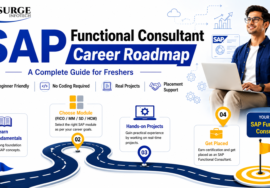
For a fresher, the ideal approach is:
SAP fundamentals → One module → Business processes → Configuration → Real-time scenarios → Projects → Interview preparation
For a working professional:
Existing domain expertise → Relevant SAP module → Configuration → Integration → Real-time projects → Certification/interview preparation
Which SAP Functional Module Should You Choose?
There isn’t one universally “best” SAP module. The right choice depends on your educational background, work experience, interests, and career goals.
SAP FICO
Suitable for candidates interested in:
- Accounting
- Finance
- Controlling
- Financial reporting
If you have a commerce, finance, accounting, or related background, SAP FICO training can be a logical specialization.
SAP MM
Suitable for people interested in:
- Procurement
- Purchasing
- Inventory
- Supply chain
- Materials management
SAP SD
A potential fit for candidates interested in:
- Sales
- Order management
- Customer processes
- Pricing
- Distribution
SAP SuccessFactors
A potential choice for professionals interested in:
- HR
- Employee management
- Talent processes
- Cloud-based HR solutions
SAP’s current learning ecosystem includes consultant-focused learning paths across different SAP products and roles, reinforcing the importance of choosing a specialization aligned with your target role.
How Can a Fresher Become an SAP Functional Consultant?
Follow a structured learning path rather than jumping between multiple modules.
Step 1: Understand SAP Fundamentals
Learn:
- What SAP is
- ERP fundamentals
- SAP S/4HANA basics
- Enterprise structures
- Master data
- Transactional data
- End-to-end business processes
Step 2: Select One Functional Module
Choose one specialization based on your background and career goals.
Step 3: Learn Configuration
Don’t stop at theory. Practice configuration in a suitable SAP learning environment.
Step 4: Work on Realistic Scenarios
Practice solving business requirements rather than simply following tutorials.
Step 5: Learn Testing and Documentation
Understand:
- Test cases
- Functional specifications
- User acceptance testing
- Defect tracking
- Business-process documentation
Step 6: Build Interview Readiness
Prepare to explain:
- Your module
- End-to-end processes
- Configuration decisions
- Business scenarios
- Project experience
- Troubleshooting approaches
Step 7: Consider Certification
SAP provides certification paths designed to validate SAP expertise, and its current certification ecosystem includes role-based learning and practical assessment approaches.
What Should You Look for in an SAP Training Institute?
If you’re comparing the Best SAP training institute or searching for SAP Training center near me, don’t choose only on price.
Evaluate:
- Trainer’s real project experience
- Module specialization
- Hands-on SAP system access
- Real-time project scenarios
- Interview preparation
- Resume support
- Placement assistance
- Batch flexibility
- Demo sessions
- Post-training support
For professionals in Mumbai, searches such as SAP professional courses Mumbai, SAP Classes with Placement, and SAP course fee in Mumbai can help identify options, but course quality should remain the primary consideration.
Also compare SAP course fees carefully. A cheaper course isn’t necessarily better if it provides limited system access or little practical exposure.
What Is the Role of SAP Real-Time Training?
SAP real-time training should focus on the type of situations consultants encounter during actual projects.
For example, instead of simply learning how to configure a feature, learners can practice:
Business Requirement → Analysis → Configuration → Testing → Issue Resolution → Documentation → Client Explanation
This approach develops both technical and consulting skills.
A strong training program should ideally combine:
- Instructor-led learning
- SAP system practice
- Real-time scenarios
- Project-based assignments
- Interview preparation
- Industry-oriented case studies
SAP also provides learning systems with preconfigured environments for learners to practice skills and prepare for projects and certifications
What Are the Biggest Mistakes Beginners Make?
Avoid these common mistakes:
- Trying to learn five SAP modules at once.
- Memorizing transaction codes without understanding processes.
- Ignoring business-domain knowledge.
- Avoiding hands-on practice.
- Depending entirely on recorded videos.
- Treating certification as a substitute for experience.
- Ignoring communication skills.
- Not learning SAP S/4HANA concepts.
- Failing to practice interview-based business scenarios.
The biggest mistake is confusing “I completed an SAP course” with “I can solve an SAP business requirement.”
Those are two very different levels of readiness.
What Is the Best Skill Combination for an SAP Functional Consultant?
The strongest profile combines five areas:
SAP Expertise + Domain Knowledge + Business Analysis + Communication + Practical Experience
Think of it this way:
SAP knowledge gets you started. Business knowledge helps you understand requirements. Practical experience helps you solve problems. Communication helps you deliver the solution.
That combination is what can make a candidate much more competitive.
Frequently Asked Questions
What are the most important skills required to become an SAP Functional Consultant?
The core skills are SAP module expertise, business-process knowledge, configuration, analytical thinking, problem-solving, communication, and practical project experience. A consultant should understand both the technology and the business requirement.
Can a fresher become an SAP Functional Consultant?
Yes, freshers can pursue SAP functional consulting by developing strong module knowledge and practical business-process skills. Real-time project exposure and interview preparation can help bridge the experience gap.
Is coding required to become an SAP Functional Consultant?
Advanced programming is generally not the primary requirement for a functional consultant. However, understanding technical concepts and how functional requirements translate into development can be extremely useful.
Is SAP FICO good for beginners?
SAP FICO can be a suitable specialization for candidates with an interest or background in finance and accounting. The right module ultimately depends on your background and career objective.
How important is SAP real-time training?
Real-time training is valuable because it allows learners to practice business scenarios, configuration, testing, and troubleshooting. Practical exposure can make theoretical knowledge more job-oriented.
Does SAP certification guarantee a job?
No certification can guarantee employment. Certification can validate knowledge and strengthen credibility, but employers also value practical skills, business understanding, communication, and relevant experience.
How much do SAP courses cost in Mumbai?
SAP course fees vary depending on the module, training format, trainer, duration, system access, project exposure, and support provided. Compare the complete learning experience rather than choosing an institute solely based on the lowest SAP course fee in Mumbai
Should working professionals learn SAP?
Yes. Working professionals can often leverage their existing domain experience when moving into SAP consulting. For example, finance professionals may explore SAP FICO, while procurement professionals may consider SAP MM.
Ready to Build Your SAP Functional Consultant Career?
If your goal is to move into SAP consulting, start by choosing one relevant SAP functional module, understand its end-to-end business processes, and gain hands-on experience through practical projects.
For learners exploring SAP professional courses Mumbai, SAP Classes with Placement, SAP Real Time Training, or SAP course fee in Mumbai, compare the curriculum, trainer experience, practical SAP access, project exposure, and career support before enrolling.
The goal shouldn’t be simply to complete an SAP course. The goal should be to become capable of solving real business problems using SAP.
If you’re exploring SAP training with practical learning and career-oriented support, connect with Upsurge Infotech to discuss the right SAP module and training path for your background.
Related Blogs



Related Videos